
Hey guys! So this post is going to be different than what I have been doing in the past. This post is about two pairs of headphones that I have been deciding between. Follow the link below and comment which pair you would choose and why. Enjoy!
Author: swimandstruggle
Been swimming for about 5 years now. I really enjoy it, and also love the challenge. I love animals and have a cat of my own named Tucker. I have 4 nieces and 1 nephew along with one brother and one sister.
The Hard Practices
There are multiple different things that I hear during swim season. Thing like the sport isn’t that hard, you guys really don’t work, I can do better than you can. You hear this day in and day out when in swimming. This is not true at all. Swimming is one of the hardest sports because of it being a water sport. We don’t get people to sub for us, there’s no time-outs, and no one else can do your race for you. This sport is about pushing yourself to the limits without causing injury. The most common injury that happens is anything with the shoulder. This is why it is very important that you make sure that you take time to stretch before and after practice, and also to make sure that you do all of warm-up and cool-down. Pushing yourself in this sport doesn’t always happen behind the scenes. Most of the time the swimming that happens at meets is the best that we can do up to that point. If we have a hard practice the day before a meet, it is harder to try and push yourself even further than what you have been doing in the past since your muscles are still sore and even in pain sometimes. If something starts to hurt, that’s when you know that you need to do something about it. It could be anything from a couple stretches to having to get a doctor’s note to have athletic tape on during meets. Another hard thing to try and focus on a lot is when to stop for your own health. You want to be able to practice and be there for your team, but sometimes you can’t be there because you’re sick. That would cause more problems if you stay, you could end up getting more people on the team sick, and then the team is down more people. In the end, you just have to know your own personal limits and don’t push past them.
This article talks about how you can learn to love practice more, so that you don’t feel as wore out or tired at the end as much as you normally would.
How To Love Working Hard At Practice
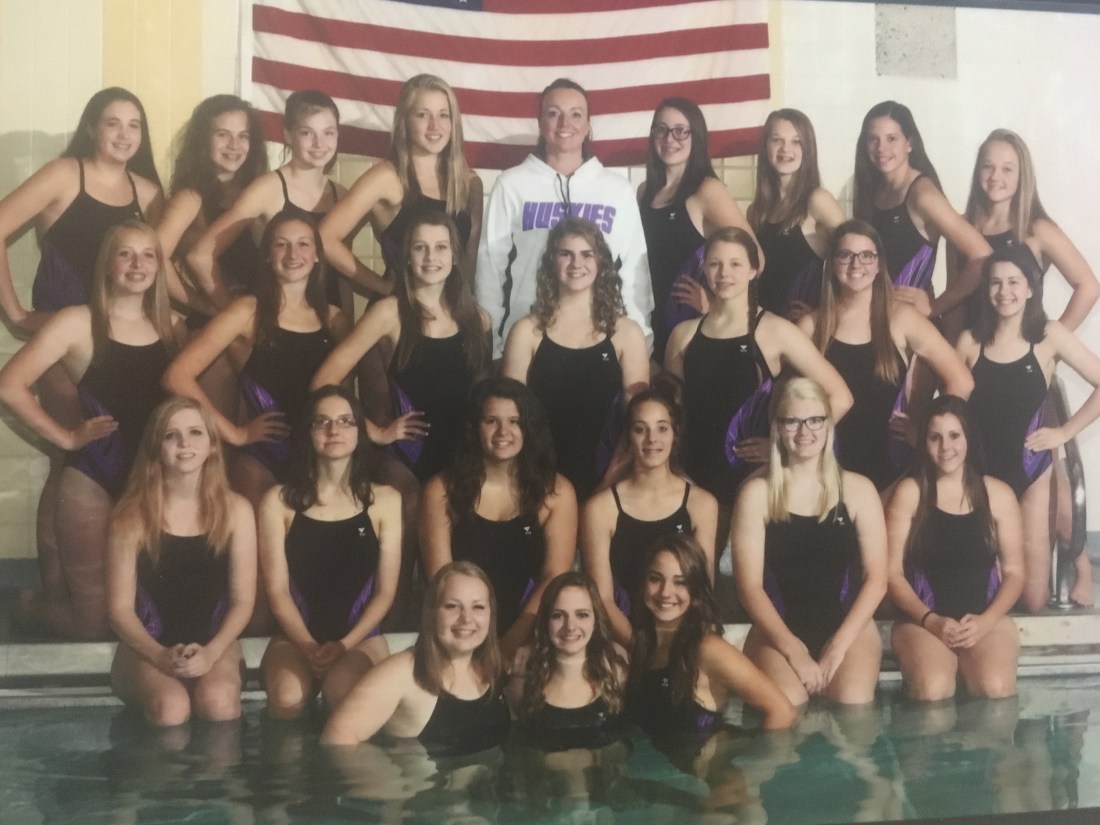
This is our team picture from my freshman year.
The Ins and Outs of Flip Turns
The most common question asked during swim season is, how do you do those flip turn things? I have been asked by swimmers and non-swimmers multiple times. It is one of the hardest things that a swimmer has to describe. Sometimes they just do it, other times it is just something that they can’t do. I have thought long and hard about this and how I would try to explain this. This is a topic that also has been brought up with other swimmers on our team. There is really no “right answer” to this question, but in my years of experience I know that there are multiple answers.
There are two different types of turns, open and flip turns. The most common type is a flip turn. This turn is used with both freestyle and backstroke. The hardest part of this flip turn is flipping fast and getting far off the wall. When you are coming close to the wall there’s a cross on the bottom of the pool. When you see that, you need to start on your turn. The first step is to make sure that you finish your stroke with one arm and pull you arm towards your waist. You need to tuck your chin to your chest with such force that you body can quickly follow your head. When you are completely flipped over you need to make sure that both of your feet slam into the wall almost straight on, and push with all of the energy that you have. And when you push off you put your arms right behind your ears, straight up with one hand on top of the other hand, this is called streamline. Then you do a couple dolphin kicks and come up to the surface of the water and keep going with your stroke.
The second type of flip turn, an open turn, is a turn that is used with butterfly and breaststroke. This turn took me a long time personally to get right. It is a turn that is more difficult and involves a few more steps. So when you are going into the wall you go all the way into the wall without going underwater. You start by placing both of your hands on the wall, if you don’t get both of your hands on the wall you will be disqualified. Then you pull your feet up with your knees to your chest. With your arms you start by slamming your elbow of one of your arms straight back. And then as you push off on your side the other arm goes right past your ear. And then when you’re in streamline position, depending on the stroke, you either do a few dolphin kicks or you would do a pull out, which I will explain later on, and go right back into your stroke.
And So It Begins…
Hi there, my name is Sarah and I created this blog to be able to talk about swimming and what swimmers really go through, in and out of the pool. As you can probably tell I really love swimming and it is something that I have been doing for many years. There will be talk about what’s going on in my head, what I think the coaches are thinking, and what swimming is really about to swimmers. Each person has a different experience and different thoughts than what I will be sharing with you. But this will be my story, from my point of view.
There is a very famous quote that I have used all the time. Swimming- From the outside looking in, you can’t understand it. From the inside looking out, you can’t explain it. Author- Unknown
The Journey Begins
Thanks for joining me!
Good company in a journey makes the way seem shorter. — Izaak Walton

 Sarah's Blog